## How a Swiss Freelancer Automated Client Onboarding
The hidden cost of a manual client onboarding process
For many freelancers, client onboarding looks manageable at first. A few emails, a proposal, a contract, a request for documents, maybe a follow-up invoice. But once business picks up, that “simple” process starts eating into billable time. Messages get missed, delays pile up, and the client experience becomes inconsistent.
In Switzerland, this problem shows up fast. Most businesses here are small, lean, and expected to operate with a high level of professionalism. Swiss SMEs make up more than 99% of companies, which means freelancers and small business owners are often working in an environment where responsiveness, precision, and trust matter from the very first interaction. When onboarding is slow or fragmented, it does not just create admin work. It signals disorganisation.
What changed when onboarding was automated
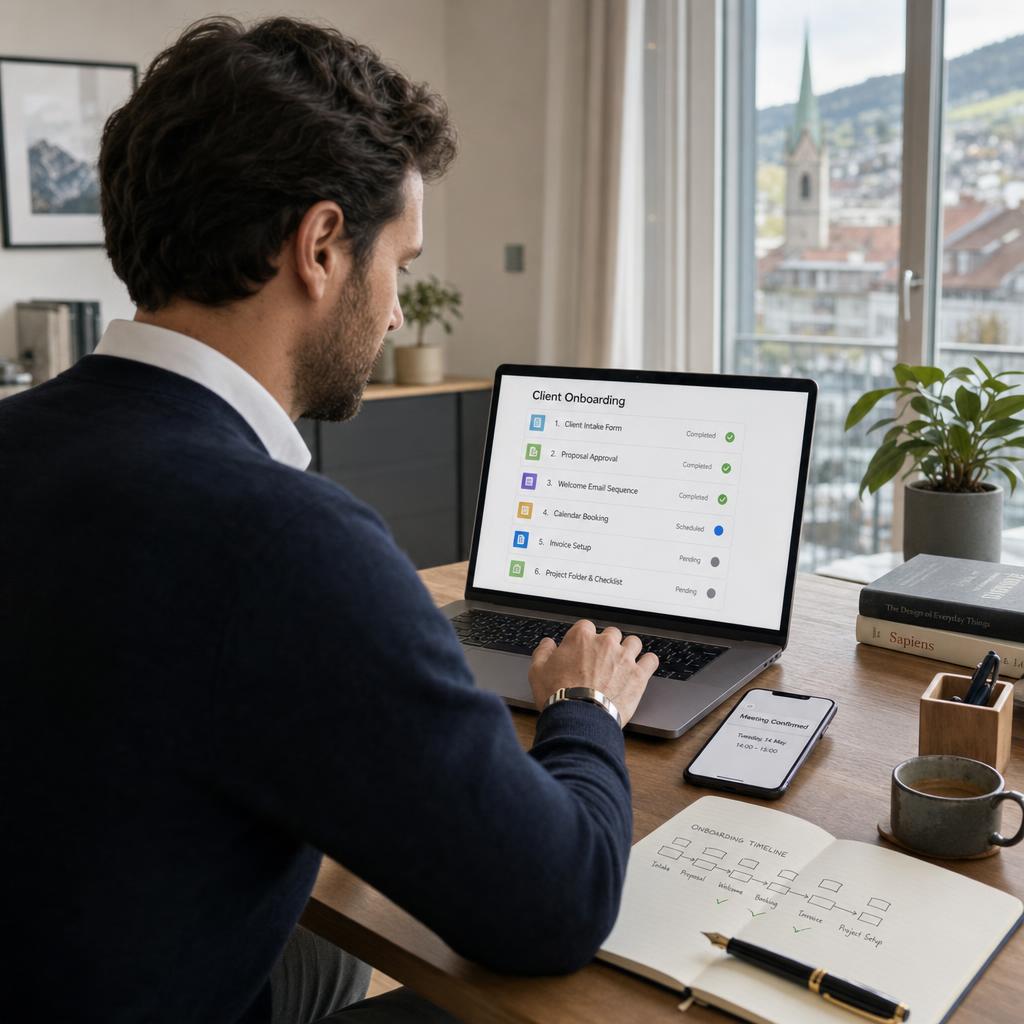
One Swiss freelancer we often see this with had a familiar challenge: every new client triggered the same repetitive chain of tasks. Initial inquiry. Qualification. Proposal. Contract. Intake form. Scheduling. Internal notes. Follow-up reminders. None of it was difficult, but all of it depended on manual coordination.
Once that workflow was automated, the impact was immediate. New clients received a smoother and more consistent experience. Internal admin dropped sharply. Response times improved. Projects started faster. Most importantly, the freelancer no longer had to mentally track every moving piece.
This is where automation creates real business value. It is not about replacing personal service. It is about removing the operational friction that makes growth harder than it should be.
Why this matters especially in Switzerland and Europe
Client onboarding in Switzerland is rarely just about speed. It also has to respect the realities of the local market: data privacy expectations, multilingual communication, and a business culture that values clarity over improvisation.
-
Swiss and European clients expect careful handling of personal and business data, especially during early-stage intake.
-
Many businesses operate across German, French, Italian, and English, so onboarding often needs structured communication rather than ad hoc back-and-forth.
-
Freelancers serving EU clients also need workflows that align with GDPR expectations, while Swiss businesses must stay mindful of the revised Swiss data protection framework.
-
In a market where reputation spreads through referrals, a messy onboarding process can quietly damage trust.
That is why custom automation matters. Off-the-shelf thinking does not reflect how Swiss businesses actually work. A freelancer in Zurich serving local SMEs has different needs from a consultant in Lausanne working across the EU. The workflow has to fit the business, the language, and the compliance context.
Automation is not a tech project. It is an operational upgrade.
The best onboarding automations are not built around tools for their own sake. Whether the stack includes n8n, Make, ChatGPT, Claude, or other components is secondary. What matters is designing a process that removes repetitive decisions, keeps information moving, and ensures every client gets the same high standard of service.
For freelancers and small business owners, the benefits are practical:
-
Less time lost to admin
-
Faster client turnaround
-
More consistent communication
-
Fewer manual errors
-
More capacity without hiring too early
That is the real reason to automate client onboarding. Not because automation is trendy, but because a business cannot scale on memory, inboxes, and good intentions alone.
For Swiss freelancers and entrepreneurs, client onboarding is one of the clearest opportunities to reduce friction without sacrificing quality. When the process is designed properly, it strengthens trust, protects time, and creates a better experience on both sides. At Chrono Labs, we help businesses turn those repetitive onboarding tasks into reliable, custom workflows that fit how they actually operate.